Wednesday, May 14, 2008

Live Blogging of Chess Tempo Session

1:42pm
so I'm working on tactics at chess tempo and I thought I'd live-blog a short session. I'm doing blitz problems. My rating right now is 2051. For the last four days I've been hovering between 2030 and 2070.

1:45pm
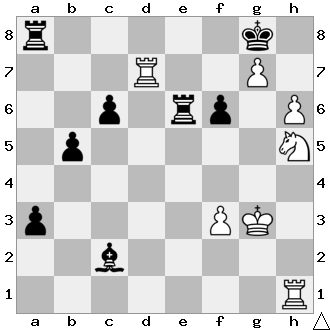
I just finished two problems that I had recently seen before. This seems unusal as chess tempo claims to have over 25,000 problems. I know I've not seen all the problems. Maybe because of my rating I don't see the really low and really high rated problems. The highest rated problem I've seen was just over 3000. I failed that one. Anyway ... the last two problem were problems I've seen before. I missed them both last time I saw them. Fortunatly I "tagged" them and I got them right this time. They were 29960 & 11726.

1:50pm
DAMN IT! I get to move six of a mate-in-seven and I screw it up. I am bothered by the fact that I miss too many tactics on the very last move ... I'm humming along, making all the right moves and I think I've got the sucker ... them bam!! I screw it up. Rating's at 2048

1:55pm
Ever see a really high rated problem, miss it and then smack yourself in the head? This one was over 2700 and it was a simple pin. I think I let the rating intimidate me sometimes.

1:59pm
I hate it when the server dishes out problems that are rated over 800 points below my rating. I just got a 1227 ... an easy 3 points. Rating's 2050 (again).

2:04pm
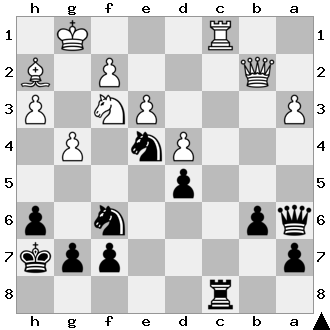
I missed a problem and I'm suspicious of the solution. I copy the position using DiagTransfer 2.0 and feed it to Fritz 8. Herr Fritz takes a baseball bat and whacks me upside the head and says, "are you a nutless, brain-dead possum?" Rating's 2047

2:09pm
I finally break even on the problems for this session (11 right, 10 wrong) Rating's 2058

2:11pm
My first instinct is to take the bishop with my rook, but then I think there might be a better move. I only have 12 seconds. Thinking, thinking ... I go with my second thought-of move ... wrong. My first instinct was correct - take the bishop. I do that alot. Rating's 2062

2:15pm
I just did it again ... the whole instinct thing. Rating's the same

2:16pm
I take 24 seconds to solve a 14 second problem and my rating goes down a point.

2:17pm
WOW! I solved a 2375 whose avg solution time is 103.8 seconds and I got it in 51 seconds! I jumped up 7 points to 2067.

2:20pm
I'm done with the last problem of this mini-session. I got it correct and finished at 2070 which means I'll probably miss 3 or 4 in a row next time I log on, have my rating drop back down to 2030 and I'll spend 30 minutes trying to get it back up to 2070.

Tuesday, May 06, 2008

Losing Streak Over

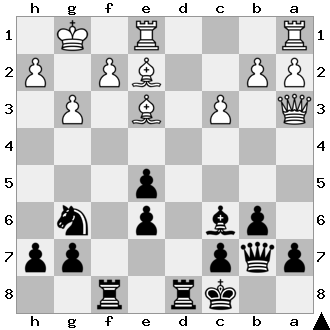
The last time I played a longish game was April 10 and I won that game ... it was my one win in the LEPers tournament. I've not played much at FICS since then. I've been focusing on my chess correspondance play at Red Hot Pawn as well as spending a lot of time at chesstempo. I just lost my 2nd game at RHP, by the way.

Tonight I logged into FICS and dinked around. I finally found a 20 5 game. My opponent kept making these annotation type comments. I usually ignore chat messages during a game. But some of his comments sounded like smack. If I remember correctly, his first comment was something like "Black up in material, White up in space and tempo" or something like that (I was playing Black). I wasn't too distracted, other than a passing thought in my head ... "wait until I shove your king into your blowhole after I deliver checkmate ya frickin' idiot!" I didn't let his smack bother me.

Pretty soon I had pretty good spacing and felt really confident. That's when he made another comment ... something like "e5 is a weak spot in the Sicilian." I probably should have paid more attention to his subtle hints. He wacked my e5 pawn and my d6 pawn could not recapture else his rook would capture my queen. Pretty soon, his white-squared bishop was hounding my king and his knight was forking my queen and rook. By this time, all dreams, hopes and aspirations of kicking this cocky SOB to Australia were dashed. I simply resigned. I had no gumption to finish it. His last comment was something to the effect that the score is now 1-1. I didn't understand at first, but then I issued a "hstat rockyrook [opponent]" and found that I had beat this fellow before. Either he issues the same command during most of his games or he must have remembered the last time I beat him (probably very soundly). That was my first longish game in a month.

Here's the game in all it's bloody glory.


The other three I played tonight were against a decent chap. The first game was kind of close until the end game. His queen and rooks really put the pressure on me. I gave it one last effort, sacrificing my rook to let my other rook and queen try to finish him off, but he defended well and I lost on time.

The 2nd game was quick and very painful. I blundered in under 7 or 8 moves. I let his queen and bishop zoom in on the f7 pawn and I could not defend it. I resigned.

The last game was a battle to the finish. I only won because I gobbled up a couple of his pawns during the course of the game. Otherwise it was pretty even. Because of the pawn advantage, I was able to trade pieces and let my pawns do the walking. He resigned. And thus the pitiful losing streak ended. My ego was almost crushed in a night of defeats, but I managed to salvage some respect before heading to bed.

Saturday, April 19, 2008

When I retire ...

... from my career, I want to do what Arthur Meether does.
he has spent the past four years volunteering his time as a chess mentor at the public library.

Heck, on my days off this Summer, I might even take my 8-year-old and 6-year-old down to the library and play and study chess for a couple of hours a day. We might even interest a few other kids to play too.

There's nothing like sitting and playing chess (or reading a good book) in a good solid wood table and chair in the quiet of the library.

Link via Susan Polgar's Blog.

Tuesday, April 01, 2008

Hillary and Rocky

No, I'm not endorsing Hillary.

I just saw on the headlines that Hillary likened herself to Rocky Balboa.

PHILADELPHIA (AP) - Sen. Hillary Rodham Clinton says she has something in
common with legendary film boxer Rocky Balboa—she's not a quitter. Recalling a famous scene on the steps of the Philadelphia Museum of Art from the 1976 Oscar-winning film "Rocky," Clinton said that ending her presidential campaign now would be as if "Rocky Balboa had gotten halfway up those art museum steps and said, 'Well, I guess that's about far enough.'"

"Let me tell you something, when it comes to finishing a fight, Rocky and I have a lot in common. I never quit. I never give up. And neither do the American people," Clinton said in excerpts of prepared remarks to be given Tuesday to a meeting of the Pennsylvania AFL-CIO.
You know what ... she is right on. She will go the distance and she will lose. Indeed, Rocky didn't quit. All he wanted to do was go the distance. He went the distance, but in the end, he lost his first fight with Apollo Creed.

Labels: ,

Sunday, March 16, 2008

LEP Round 5 and "Thanks!"

Again, no big suprise or upset. Polly ate me like a cracker. It was more of a blitz than a rapid game.

I also wanted to thank DK and Chess Teacher for the helpful suggestions. I've increased the number of posts displayed on the main page and I fixed the height of the chesspublisher so that you don't have the scroll bar to the right.

Not much chess for me this past week or this week ... the kids are on Spring Break and I'm working the night shift, so I'm spending lots of time at Chess Tempo.

Sunday, March 09, 2008

LEPers Round 4: Another Loss

No suprise here. Kevin TCB and trashed me. I personally was impressed I lasted as long as I did. The game wasn't really special, so I won't bother posting it.

Friday, March 07, 2008

RockyRook v. ChristofRomyuod

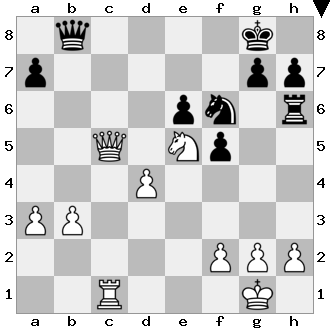
So I got a 60 5 game in this week. My opponent was about 150 rating points higher than me. It was a close game. He had a chance to close the game early at with 31 ... Qxc3 but he let me off the hook. I rallied back and made it interesting, but his advanced pawns were too much for me to manage in the end.

This is my first time using chesspublisher. I hope it works.

3-Way Chess

Check out this version of chess . I've heard of this, but had not really seen it before. Click on the link here to see this blog post on it.

I searched 3-way chess at wikipedia and found a link to Three-handed Chess.

From the above wikipedia page, I found more information on Three Player Chess. It looks like sometime in the mid 1990's this chess variant was invented.

I can hardly manged the normal chess board and complexities. But adding a third player to the mix makes for a very interesting and complex game. As one of the posts pointed out, if two of the players don't like the 3rd, then the 3rd player is doomed.

Tuesday, March 04, 2008

The Dimock Theme Tournament NY 1924

I stumbled on this fantastic site today. It has all the annotated games from a tournament of strong US players, including Marshall, from 1924. From that site there are other links to chess stuff. I might be hanging out at that site for quite some time.

Monday, March 03, 2008

Match Request: March 6-8 @ 18:00 FICS

As usual, I'm looking to play a 60 5 game on FICS.

I'll be available March 6th, 7th and 8th at around 18:00 FICS (Pacific) time.

I'd prefer to play someone in the 1700-1800 range, but will play anyone over 1600.

I NEED the practice! :-)

If you're interested, leave a comment.

Sunday, March 02, 2008

Three Rounds, Three Loses

OK. The bright side of this predicament is that things can only go up from here. If I lose, then my streak continues (which is fine ... I like streaks). If I win, then it will be the biggest upset of the tournament. I mean if you can't beat me, then you must really suck! :-)

I played really fast in the last two games. In the last game against LEP, I think I had over 21 minutes on my clock when he check-mated me. I should probably work on time management a bit. But what's even more frustrating is taking all that time, thinking deliberately, being careful and having my clock drip down to a minute, and then I make a mistake ... it floors me every time. But if I treat it like a blitz game, then I can always fall back to the excuse, "well, I was playing fast. No big deal." And if I take that approach, the frustration of losing is much, much less.

Bottom line: I'm a slow thinker and learner. I have to take my time every move or else I will foul it up. And even if I take lots of time, I'm still known to make critical mistakes ... all the more reason for me to play longer games (and why I like correspondance chess so much).

But to all the LEPers ... don't take this the wrong way. If this tourny were a 45 45 or G90, chances are I'd still be 0-3.

How to Think Article

Very interesting stuff.

Link.

Entire article:

How to Think
Managing brain resources in an age of complexity.

Tuesday, November 13, 2007

When I applied for my faculty job at the MIT Media Lab, I had to write a teaching statement. One of the things I proposed was to teach a class called "How to Think," which would focus on how to be creative, thoughtful, and powerful in a world where problems are extremely complex, targets are continuously moving, and our brains often seem like nodes of enormous networks that constantly reconfigure. In the process of thinking about this, I composed 10 rules, which I sometimes share with students. I've listed them here, followed by some practical advice on implementation.

1. Synthesize new ideas constantly. Never read passively. Annotate, model, think, and synthesize while you read, even when you're reading what you conceive to be introductory stuff. That way, you will always aim towards understanding things at a resolution fine enough for you to be creative.

2. Learn how to learn (rapidly). One of the most important talents for the 21st century is the ability to learn almost anything instantly, so cultivate this talent. Be able to rapidly prototype ideas. Know how your brain works. (I often need a 20-minute power nap after loading a lot into my brain, followed by half a cup of coffee. Knowing how my brain operates enables me to use it well.)

3. Work backward from your goal. Or else you may never get there. If you work forward, you may invent something profound--or you might not. If you work backward, then you have at least directed your efforts at something important to you.

4. Always have a long-term plan. Even if you change it every day. The act of making the plan alone is worth it. And even if you revise it often, you're guaranteed to be learning something.

5. Make contingency maps. Draw all the things you need to do on a big piece of paper, and find out which things depend on other things. Then, find the things that are not dependent on anything but have the most dependents, and finish them first.

6. Collaborate.

7. Make your mistakes quickly. You may mess things up on the first try, but do it fast, and then move on. Document what led to the error so that you learn what to recognize, and then move on. Get the mistakes out of the way. As Shakespeare put it, "Our doubts are traitors, and make us lose the good we oft might win, by fearing to attempt."

8. As you develop skills, write up best-practices protocols. That way, when you return to something you've done, you can make it routine. Instinctualize conscious control.

9. Document everything obsessively. If you don't record it, it may never have an impact on the world. Much of creativity is learning how to see things properly. Most profound scientific discoveries are surprises. But if you don't document and digest every observation and learn to trust your eyes, then you will not know when you have seen a surprise.

10. Keep it simple. If it looks like something hard to engineer, it probably is. If you can spend two days thinking of ways to make it 10 times simpler, do it. It will work better, be more reliable, and have a bigger impact on the world. And learn, if only to know what has failed before. Remember the old saying, "Six months in the lab can save an afternoon in the library."

Two practical notes. The first is in the arena of time management. I really like what I call logarithmic time planning, in which events that are close at hand are scheduled with finer resolution than events that are far off. For example, things that happen tomorrow should be scheduled down to the minute, things that happen next week should be scheduled down to the hour, and things that happen next year should be scheduled down to the day. Why do all calendar programs force you to pick the exact minute something happens when you are trying to schedule it a year out? I just use a word processor to schedule all my events, tasks, and commitments, with resolution fading away the farther I look into the future. (It would be nice, though, to have a software tool that would gently help you make the schedule higher-resolution as time passes...)

The second practical note: I find it really useful to write and draw while talking with someone, composing conversation summaries on pieces of paper or pages of notepads. I often use plenty of color annotation to highlight salient points. At the end of the conversation, I digitally photograph the piece of paper so that I capture the entire flow of the conversation and the thoughts that emerged. The person I've conversed with usually gets to keep the original piece of paper, and the digital photograph is uploaded to my computer for keyword tagging and archiving. This way I can call up all the images, sketches, ideas, references, and action items from a brief note that I took during a five-minute meeting at a coffee shop years ago--at a touch, on my laptop. With 10-megapixel cameras costing just over $100, you can easily capture a dozen full pages in a single shot, in just a second.

Cite as: Boyden, E. S. "How to Think." Ed Boyden's Blog. Technology Review. 11/13/07. (http://www.technologyreview.com/blog/boyden/21925/).

Friday, February 22, 2008

Match Request: February 22 @ 18:00 FICS

Anyone up for a 60 5 game tonight on FICS at around 18:00 FICS (Pacific) time?

Leave a comment or just log on to FICS tonight and look for my seek.

Thursday, February 21, 2008

Round 2 LEPers - RR v RLP

I really think I'm over-rated for this tournament. I knew I was going into it and now at 0-2, I've got proof.

This game was a quick game. Going into it, I had to battle an inferiority complex against the famous Wahrheit. I played him in my very first correspondance game at RedHotPawn. He pwned me big time. Since that loss, I've won every single CC game. Plus, he is a very, very smart and intelligent human being ... just read his blog.

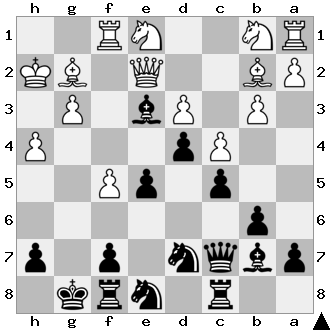
So I tried to play aggressive. It obviously didn't work. He sliced and diced me like a chef making a salad. I was a head of lettuce going into the game and came out stuffed in a bag ready to be made into cole slaw.

Here is where it all came unraveled.

Oh well. There's always next week.

Wednesday, February 13, 2008

Round 1: LEPers - TheDarkKnightTwo v. RockyRook

The first round of the tournament of LEPers is on. TheDarkKnightTwo and I played. Both our clocks dripped down to a minute. For a few moves towards the end, at least one of our clocks dipped below a minute. I tend to get nervous as it is, but to add time pressure was worse.


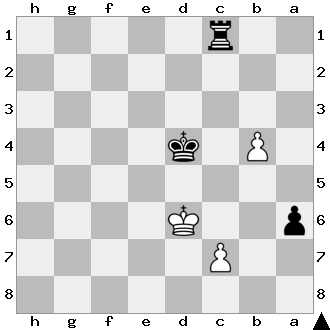
In the end, TheDarkKnightTwo won when he pretty much guaranteed either a pawn promotion or by capturing my hanging rook. After Na6, I resigned.


I had my chance when I missed a hanging pawn. Last night was so long ago, but I seem to recall seeing this move. But I didn't realize I missed it until Herr Fritz subtly pointed it out this morning. I exchanged queens, but missed the hanging knight. Of course had I seen the proper move, I was still fighting a formidable opponent who would not go down easy.

Wednesday, February 06, 2008

"The Inner Game of Chess" and Flow

I've been meaning to post about Robert's latest post entitled "The Inner Game of Chess"

In one sentence, he perfectly captured (at least in my mind) what flow means or feels like in a game of chess. He said, "the rest of the tournament room, and the world, sort of faded away, and all I saw was the board in front of me."

He goes on to explain that between moves 22 and 30 he begins to tire from previous calculations. Then he ties in Blunderprone's very insightful post about his 7-move loss and a quote from FM Jon Jacobs who succinctly advises a chess player to "Fire Your Coach. Hire a Shrink!"

All of this is very good stuff and it relates directly to flow.

For all the good that De la Maza did in his little theory on cramming tactics into your head, one tiny yet important fact that is overlooked in his success story is that he seemingly had a lot of time to dedicate to chess. Wouldn't we all be much better if we didn't have day jobs, families and other responsibilities taking precious time away from chess?

Despite having our time spread across multiple interests, we can still attain that intense focus required to play our best chess. This is where flow comes in.

I think the commenter on Robert's post who's identified as Howard Goldowsky made an excellent point. He said, "it's not good enough to want to have a certain mindset, one must meditate on that mindset each day, train your brain to behave the way it wants to behave. There's so little time to train on the technical side of chess, taking the time to meditate would be a big investment"

This comment reminds me of what I read recently in the popular book Zen and the Art of Motorcycle Maintenance. The author tells his friends about a set of instructions he keeps at his home which help him improve in his field of technial writing. The set of instructions simply state, "Assembly of Japanese bicycle require great peace of mind" (see chapter 14 of the book).

Obviously the underlining statement here is, "you better have a clear head before you begin assembling this bike!" To apply this to chess and flow ... you must have "great peace of mind" going into a game of chess in order to attain flow and consequently play your best chess.

I believe that we can practice getting into that flow. Perhaps through meditation or deep breathing or listening to certain music or other pre-game rituals we attain the proper mindset going into a game or practice session (studying a book or solving tactics and positions).

Alas, I have no conclusive evidence right now ... it's just a gut feeling. But I'm willing to experiment.

Monday, January 14, 2008

Entire Article on Flow

The link to the article about flow from my previous post went dead. I found it again here.

But in case that link goes dead, I'll paste the entire article in this post.

In the Zone
Seeking that Zen state of “flow” helps us to excel in sports and in life
by Dave Philipps

The approach to pro snowboarder Jeff Meyer’s favorite jump in the snowy backcountry near his Breckenridge home is steep and narrow. He has to clear an old mine while keeping just the right speed.

“If you mess up, there’s a good chance you could die,” he said recently. But he doesn’t think about that as he’s shooting down toward the hit. He doesn’t really think about anything. “I’m just there, totally in the moment, in a heightened state of existence.”

It’s the same invincible feeling Olympic track cyclist Erin Mirabella occasionally grasps while flying around the velodrome.

“You’re going all out. By the end you can’t walk, you can’t see straight, you count down every second. Everything hurts,” said Mirabella. “But sometimes, it just clicks. Time almost doesn’t exist. There’s a oneness, a wholeness. You’re going on instinct. You just let your body take over.”

When that feeling of wholeness washes over ultra-runner and Leadville Trail 100 winner Anton Krupicka when he’s on the trail, pain and fatigue seem to evaporate.

“It almost feels like I’m running downhill,” he said. “It’s this feeling of total integration with your surroundings, everything being in its right place, a harmonious way of being... It’s about as spiritual and religious as I get.”

There are many names for this sport-induced hypersense of focus and awareness: “being in the zone,” “when things click” or “a Zen state.”

Whatever you call it, psychologist Mihaly Csikszentmihalyi (pronounced “chick-sent-mehigh-ee”), said the feeling may be not only the fuel driving our desire to snowboard or bike or run. It may be the reason we sing, paint, climb mountains, play chess, compose symphonies, build smaller microchips or do anything difficult. Basically, Csikszentmihalyi said, flow may be what makes humans human.“

It’s amazing, how universal it is,” said Csikszentmihalyi, a Claremont Graduate University (California), professor who has been studying the feeling he calls “flow” since he coined the term as a rock-climbing grad student the 1960s. “In every culture we’ve studied, it exists in the same form.”

Women who weave tapestries in the highlands of Borneo, meditating monks in Europe and mountain bikers in the Rockies all report that when they do what they love to do, they occasionally get so engaged they forget time, stop thinking about other obligations, and feel as if they became one with what they were doing.“

So many people compared it to being carried away by an effortless current that I decided calling it flow made sense,” said Csikszentmihalyi.

Of course, the idea of being so absorbed in the moment that you feel as if you can act without thinking was a familiar concept in Eastern religion long before flow. For millennia, followers of Taoism and Zen Buddhism have strove, through meditation, study and arts as varied as sword fighting and flower arranging, to become one with an elusive larger harmony.

Freestyle snowboarding is a fitting, modern way to chase the Zen state, said Meyer. For years he had no words for the transcendent euphoria he felt in the commitment and concentration of going into a tricky jump. Then he found “satori,” a Zen Buddhism term that means “understanding.”

He explains it this way: “Say you and I are standing in a room. I’m holding a baseball. I can look at you and without saying anything, toss you the ball. Chances are you’ll instinctively catch it. That brief time when the ball is in the air, you’re completely focused on it.

You know what you’re going to do, and you’re not thinking about your mortgage. You’re not thinking about whether your back hurts. You’re not thinking anything else. That’s satori. It’s a rush.”

It’s why he’s devoted himself to snowboarding. No other action can deliver the same feeling.

But flow is different for everyone. You don’t have to be an extreme sports pro to get the rush. Drawing, a good match of chess, playing a guitar or making first tracks on a powder day can do it. About 12 percent of the population reports never entering a state of flow, said Csikszentmihalyi. An additional 10 percent reports experiencing it daily. Most of us, though, experience it once every few months.

“You can’t make it happen,” said Krupicka. “But if you do certain things, it’s definitely more likely.”

For Krupicka, the Colorado Springs runner, flow happens only when running, especially alone on beautiful mountain trails.

“I’ve tried a bike and it just doesn’t work, but if I’m on the right trail, and in the right mood, I can run for, like, seven hours and it’s like my legs are turning over by themselves.”

The real formula for creating flow is finding the proper balance between skill and challenge, said Csikszentmihalyi. If something is too easy, it becomes boring. If something is too hard, stress elbows out flow. But if you are performing well at the edge of your skill level, you can enter that trance-like state where everything else ceases to matter. From an evolutionary point of view, Csikszentmihalyi said flow seems to make sense.

“When you look at the basic things our species needs to do in order to survive, like eating or have sex, those activities are very pleasurable to us. If they weren’t, we might disappear as a species,” he said. “I think it’s the same thing with flow. Flow means enjoying challenges and wanting to have more of them.”
—MCT

Labels:

Wednesday, January 09, 2008

Flow

In my previous post, I asked a few questions about motivation ... desire ... drive. How do we instill motivation within ourselves? Can it be instilled as an adult or does it have to be done in childhood? Can it be planted or does it come naturally?

Today I came accross an article about flow. I've heard of flow before, but have forgotten about it since my college days.

Another way to describe flow is "being in the zone" or "when things click" or "a Zen state."

Whatever you call it, psychologist Mihaly Csikszentmihalyi (pronounced
"chick-sent-mehigh-ee"), said the feeling may be not only the fuel driving our desire to snowboard or bike or run. It may be the reason we sing, paint, climb mountains, play chess, compose symphonies, build smaller microchips or do anything difficult. Basically, Csikszentmihalyi said, flow may be what makes humans human.

This makes sense to me. Personally, I think this is why I love to study and play chess so much. I remember playing a game of chess with my dad almost every Sunday evening for a stretch of several years when I was a kid. I loved the feeling of being in the game ... I was totally committed to the game. Since that time, I've played many games where I found that "zone" and I felt as though I could see everything.

I've been in the "zone" not only when playing chess, but when I've played basketball. I had games where I was in such a flow, that I could simply throw up a shot and it would go in. Of course those times are rare, but that is what made me go back for more. The same goes for chess ... once I tasted that flow in the game, I loved it and wanted more of it. This is why I could study and play chess all day long.

Another quote from the article:
Women who weave tapestries in the highlands of Borneo, meditating monks
in Europe and mountain bikers in the Rockies all report that when they do what they love to do, they occasionally get so engaged they forget time, stop thinking about other obligations, and feel as if they became one with what they were doing.

The article ends with a list entitled "THE EIGHTFOLD PATH TO FLOW"
1. Simplicity: You have a clear goal to achieve.
2. Confidence: You know you have the skills to accomplish your goal.
3. Challenge: What you're doing, whether it's playing chess or skiing a 14,000-foot peak, isn't easy.
4. External focus: There are limited outside distractions.
5. Internal focus: There are limited distractions in your mind.
6. You are not focused on a future outcome (i.e. winning or losing) but only on the present.
7. You are in complete control of your actions.
8. You relax.

What are your flow experiences? Do you do anything special to get in the flow?

I can think of a few things I do to try to get in the flow. For basketball, I find that when I watch highlights of Michael Jordan or other NBA players, I "get pumped up" and I feel my confidence soar. For running ... there wasn't a whole lot I could do. Some days I just had it and other days totally sucked.

As for chess ... I really have to limit the external distractions. I can really never focus on chess until my wife and family are happy and life is generally under control. Once that is in check, I settle in at my desk and begin to practice tactics. I try to relax my mind and eyes so that I see everything on the board. After several tactics, I will know if I'm feeling it or not. I've gotten much better at consistently getting in the zone, but there are still times when it doesn't matter what I try, I just can't get there.

I don't think I've answered all of my questions, but I think I'm on the right track.

Labels:

Sunday, December 30, 2007

Thoughts on "My Brilliant Brain: Make me a Genius"

Spurred by Wormwood's post on the Susan Polgar segment of the three part series entitled "My Brilliant Brain", I decided to watch the documentary. The part in which Susan appears is called "Make me a Genius."

As I watched the presentation, I jotted down a few things that really caught my attention. There wasn't anything new I learned or haven't heard before, but it's just the fact that I was reminded of certain critical factors that are very important in life and chess.

Desire - Motivation - Drive

Whatever you want to call "it", "it" is absolutely essential in succeeding in life, chess and any other pursuit.

At 6:53 in the video, the narrator explains that Lazslo "was convinced he could train his daughter to be a genius at anything as long as she was a willing student." (emphasis added)

Later at 7:11, Susan says, "It's very important for a child to love the specific field, which in our case was chess and then the rest comes easy." (emphasis added)

On a slight tangent, I read an article in the Dallas Morning News about Chase Daniels ... the QB for Missouri. Early in Chase's childhood, his father Bill recognized Chase's abilities and decided to "make that boy an athlete."

The article continued,

When Bill laid out his plan to Chase, he promised to get the boy all the coaching and skills development he might need. Father asked for only one thing: that the boy commit to dedicate every fiber of his being to workouts and practices and games. There would be plenty of time to be one of the boys off the field. On the field, the boy would have to be a man.


Even before Bill could dangle Chase's beloved smoothies as a reward for successful practice sessions to come, Chase agreed to try. What boy wouldn't, he wondered.

"My dad wanted me to be the best I could be," Chase Daniel recalled. "I had a similar goal. I wanted to be the best."

A common thread can be seen ... a desire to suceed and a parent to help him or her along.

How do you instill this drive within yourself? Can "it" be instilled as an adult or does it have to be done in childhood? How do you plant "it" in your child? Can "it" be instilled and planted or does "it" just have to come naturally? I don't fully know the answers to these questions, but I want to look into it. Stay tuned for more on this in another post.

Intuition

Around 30:30 the topic of intuition is broached. I noted that intuition was defined as trusting your experience and that chess players rely more on intuition than calculation.

Now this was a little new to me and somewhat of an epiphany. When I solve problems at ChessTempo and when I'm playing games, it feels as though my brain is churning ... chugging along trying to find and calculate tactics. However, I sometimes note what my first reaction is when I look at a position and then compare it to what the answer was. Sometimes I'm spot on while other times I'm way off. I'm curious to know how often my "gut" is right. I'm thinking about gathering some statistics from my time spent at ChessTempo ... how often is my initial response to the position correct? Again, more fodder for posting.

Susan defines intuition as "guessing intelligently basing it on prior games and experiences" (34:08). When I heard her explain intuition this way, a little light bulb went on in my head ... this is exactly why I need to play as many slow games and go over as many GM games as possible ... to get that "experience."

Now I can hear everyone collectively say, "Gee whiz Rocky, we've all known that for ages! Where have you been this whole time?" I know, I know ... I have a very thick skull and a lot of times the uptake isn't too quick with me. It takes several iterations for stuff to sink in. It's just the way it was explained to me in the video that made the light go on.

Pattern Recognition

Nothing really new here. But the video did talk a lot about pattern recognition. One of the points from the video was that pattern recognition separates the best from the rest. Susan studied and memorized so many important patterns over and over again, that it became second nature for her to make a move when she encountered one of those patterns. They became hard-wired into her brain.

I still like Dan Heisman's analogy the best. He compared learning tactics to memorizing the multiplication table. At first, it was difficult to memorize the table. But soon I was really quick about it. I remember we would have speed competitions in grade school to see who could finish the table the quickest. The same must be done with tactics and other patterns.

Overall, I really enjoyed the video. I'm going to find the other two segments and watch them too. I love NatGeo!

Have a Happy and Safe New Year!

Wednesday, December 19, 2007

FICS SurveyBot

I don't see many opportunities for me to play OTB tournaments and establish a USCF anytime soon. Our kids are still fairly young and we are devoting a lot of our time to their interests. As such, I won't be able to play OTB very often.

Therefore, FICS will be the preferred venue for my play.

FICS has a survey bot that allows players to sumbit their USCF ratings. From there, regression analysis is completed to give us a fairly good comparasion between FICS ratings and USCF ratings.

Every time I update my rating status on my improvment plan page, I'll update this page with the latest analysis. I'll indicate where my FICS rating falls in the scale by highlighting it.

The command to get this report is "tell SurveyBot ratings USCF analyse"

December 19, 2007 Analysis
: FICS USCF
: ---------
: 1220 839
: 1240 873
: 1260 908
: 1280 942
: 1300 975
: 1320 1008
: 1340 1040
: 1360 1072
: 1380 1103
: 1400 1134
: 1420 1164
: 1440 1194
: 1460 1224
: 1480 1253
: 1500 1282
: 1520 1310
: 1540 1338
: 1560 1366
: 1580 1393
: 1600 1420
: 1620 1447 <---
: 1640 1473 <---
: 1660 1499
: 1680 1525
: 1700 1550
: 1720 1575
: 1740 1600
: 1760 1624
: 1780 1649
: 1800 1672
: 1820 1696
: 1840 1720
: 1860 1743
: 1880 1766
: 1900 1788
: 1920 1811
: 1940 1833
: 1960 1855
: 1980 1877
: 2000 1898
: 2020 1920
: 2040 1941
: 2060 1962
: 2080 1982
: 2100 2003
: 2120 2023
: 2140 2043
: 2160 2063
: 2180 2083
: 2200 2103
: 2220 2122
: 2240 2141
: 2260 2160
: 2280 2179
: 2300 2198
: 2320 2217
: 2340 2235
: 2360 2253
: 2380 2271
: 2400 2289
: ---------
SurveyBot(TD) tells you: A list of the estimated USCF ratings has been displayed above. The 164 submitted USCF ratings fit the best logarithmic curve given by formula USCF=a+b*ln(FICS), where a=-14397.65344145, b=2144.02597249 and coefficient of determination r^2=0.624.
***********************************************************


Powered by Blogger
& Blogger Templates